
Stanford CS 377U · Academic Product Concept & Prototype · 2024
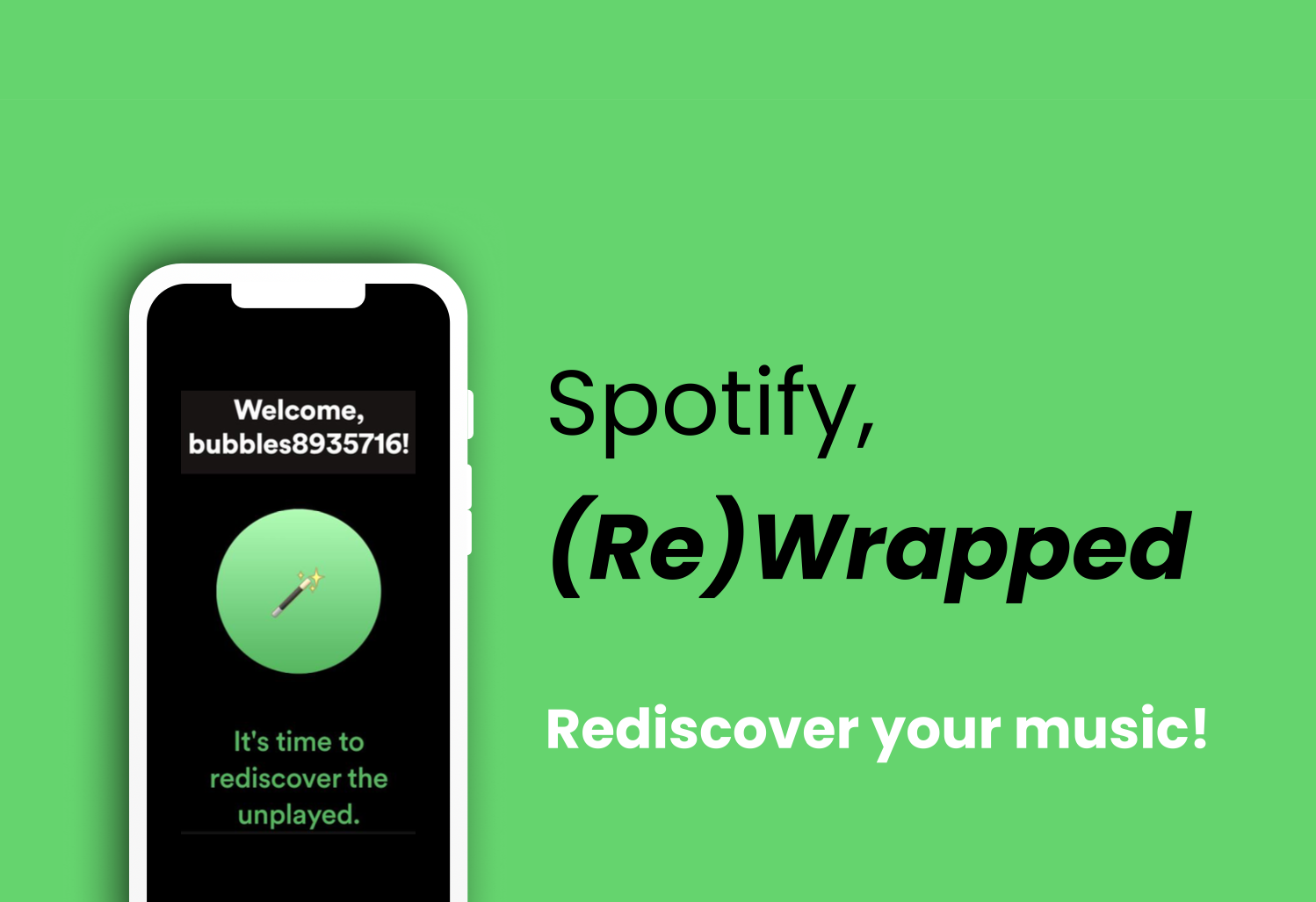
Spotify (Re)Wrapped
Helping listeners rediscover the music they saved, loved, and forgot.
Academic concept project. Not affiliated with or endorsed by Spotify. "(Re)Wrapped" was a playful framing device for a rediscovery experience.
ROLE
Co-lead designer & researcher
TIMELINE
Apr - Jun 2024
TEAM
4-Person Collaboration (Sophie Chen, Helen He, Anchal Sayal, Jasmine Steele)
FOCUS
Figma, Spotify API, Node.js, Heroku
Co-led user research and product definition, shaped the end-to-end interaction flow and high-fidelity experience, and helped build and test the API-connected prototype with the team.
The problem
Saved music doesn't disappear. It becomes invisible.
Over time, listeners accumulate songs tied to moods, memories, and phases of life, but rarely revisit them. The problem wasn't a lack of music. It was a lack of meaningful ways back to music they already loved. Spotify offers no intentional way to return to it, and that gap only grows as libraries expand and algorithmic feeds keep prioritizing novelty over memory.
What we learned
Five interviews with Spotify users, from casual listeners to heavy playlist-makers, pointed to the same idea: people didn't just want new music. They wanted better ways back to music that already belonged to them. Saved songs acted as an archive, a memory bank, a mood tool, an identity marker. They were rarely revisited unless something prompted it.
Personas
Different listeners, different relationships with saved music
From the interviews, we saw a few recurring patterns in how people saved, organized, and returned to music. We synthesized those into lightweight personas to keep those differences visible as we started designing.
The Archivist
Saves heavily and uses music to preserve moments, moods, and periods of life.
The Comfort Listener
Returns to familiar music and values recognition more than constant novelty.
The Passive Saver
Accumulates liked songs over time but rarely organizes or revisits them.
Creating (Re)Wrapped as a concept
Across the personas, one common need emerged: an easier way back to music people had already cared about, even though the reasons that music became ‘forgotten’ differed.
We framed the idea as Spotify (Re)Wrapped. Instead of summarizing what users had recently played, it resurfaced music they once saved but had stopped hearing. The personas reinforced that rediscovery needed to feel personal and lightweight rather than like another recommendation feed.
Exploring the flow
We started on paper, working through three questions before writing a line of code: what counts as a forgotten song, how a rediscovered song should be presented, and what a listener should be able to do with it afterward. Early feedback validated the emotional pull of rediscovery — and surfaced the first real risk: nobody wanted a black box deciding what deserved to come back.
Early prototype flow: Connecting a Spotify account and generating a rediscovery moment from real saved music.
Designing for rediscovery
The early research and prototype feedback translated into three interaction principles. Each one shaped how the experience should present resurfaced music and how much authority the system should have.
Building it for real
Static screens couldn't answer the real question, so we built a working prototype on the actual Spotify API, Node.js, and Heroku: connecting to a participant's real account and generating rediscovery from their own saved music. Testing against real listening histories made the research dramatically more personal than any mockup could.
What broke the concept
An 11-person field study confirmed rediscovery felt good — nostalgic, surprising, useful — but also showed it couldn't succeed as a purely automated feed.
The personas had captured different listening behaviors, but the field study exposed an even deeper difference: “forgotten” itself meant something different to different people.
What I’d build next
The field study pointed to one strongest next step: a rediscovery model flexible enough to serve the different listener behaviors we had seen in both the personas and the field study.
Let users define "forgotten" by time range, listening frequency, genre, artist, or playlist source.
Show why each song was resurfaced.
Support lightweight actions that don't automatically clutter the user's library.
Make authorization and data access clearer before account connection.
Offer temporary rediscovery sessions rather than permanent playlist changes by default.
Together, these would make rediscovery feel less like an opaque feed and more like a collaboration between the listener and the system.
What the project established
The core pivot
Rediscovery worked emotionally, but only when the system stopped deciding everything for the listener.
Reflection
The strongest part of this project was not the original feature concept. It was the shift in our understanding of the problem: music platforms optimize for discovery of the new, but rediscovery only becomes meaningful when listeners can shape it, understand it, and decide what happens next.
Because this was academic, we moved quickly from interviews into prototyping. Our early personas helped us organize the listener differences we had already observed, but in a real product setting I’d spend much more time validating and expanding those segments before solutioning, including understanding how different listener segments already revisit saved music, and whether "forgotten" is even the right frame for the problem. That earlier research likely would have surfaced the need for control and trust before the field study had to teach it to us the hard way. Research isn't only for testing whether a solution works. It's for making sure you're solving the right problem before you invest in one.