
VIRTUAL VOGUE
The psychology of AR clothing
"Although the saying goes that clothes do not make the man, our results suggest that they do hold a strange power over their wearers."
— Adam & Galinsky, "Enclothed Cognition", 2012
FOCUS
Research, AR prototyping, experiment design
TEAM
Helen He, Hyunseok Hwang, Karson Lippert
CLASS
Stanford CS 347: Human-Computer Interaction: Foundations and Frontiers
WHEN
March 2023
02 — Premise
If physical clothing can affect cognition, can virtual clothing do the same?
Inspired by research on enclothed cognition, we designed an AR experiment where participants saw themselves wearing a virtual coat. The coat was visually identical across conditions, but labeled differently: either as a doctor's coat or a painter's coat.
Prior research suggests clothing shapes behavior when it carries symbolic meaning. We wanted to know: if a participant only sees themselves wearing a coat through AR, does that symbolic meaning survive the jump into the virtual?


03 — Experiment
We built an AR coat in Snapchat Lens Studio and tested it with 35 Stanford undergraduates.
Participants completed a short embodiment activity — looking at themselves in the AR coat and moving around to make the outfit feel present — then completed cognitive tasks measuring attention, creativity, and memory. The manipulation was simple: the coat looked identical across conditions, but participants were told it was either a doctor's coat or a painter's coat, cued by a Snapchat QR label. Both coats above are the same garment.
One coat. Two identities.
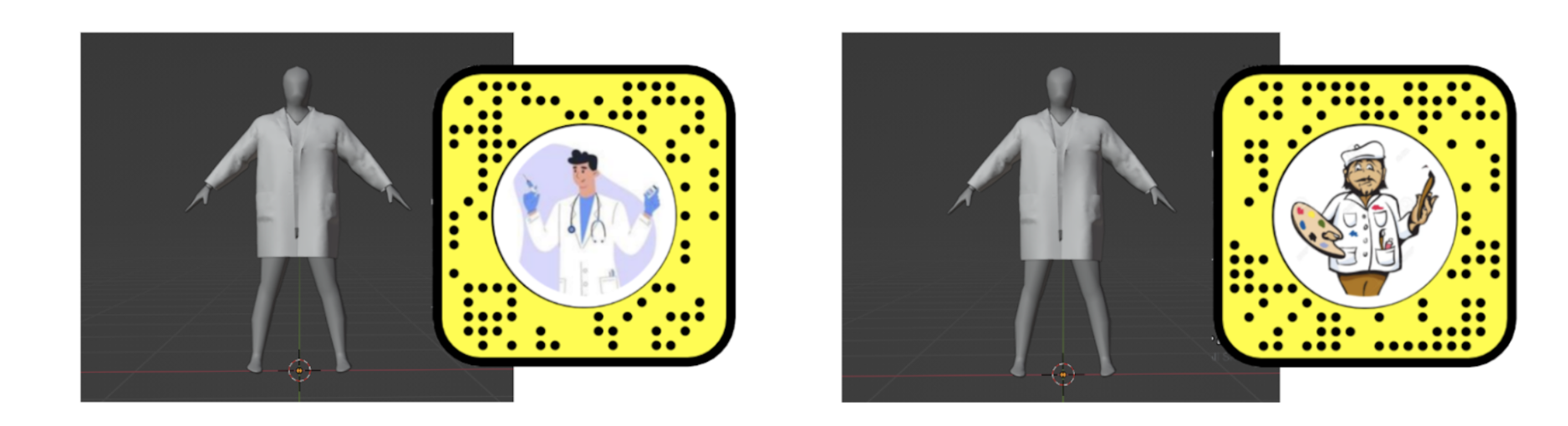
The doctor’s coat (left) and painter’s coat (right) used in the experiment. Both coats are actually identical. The only difference is whether they’re labeled “doctor’s” or “painter’s,” thus influencing wearer’s symbolic perception of coat.
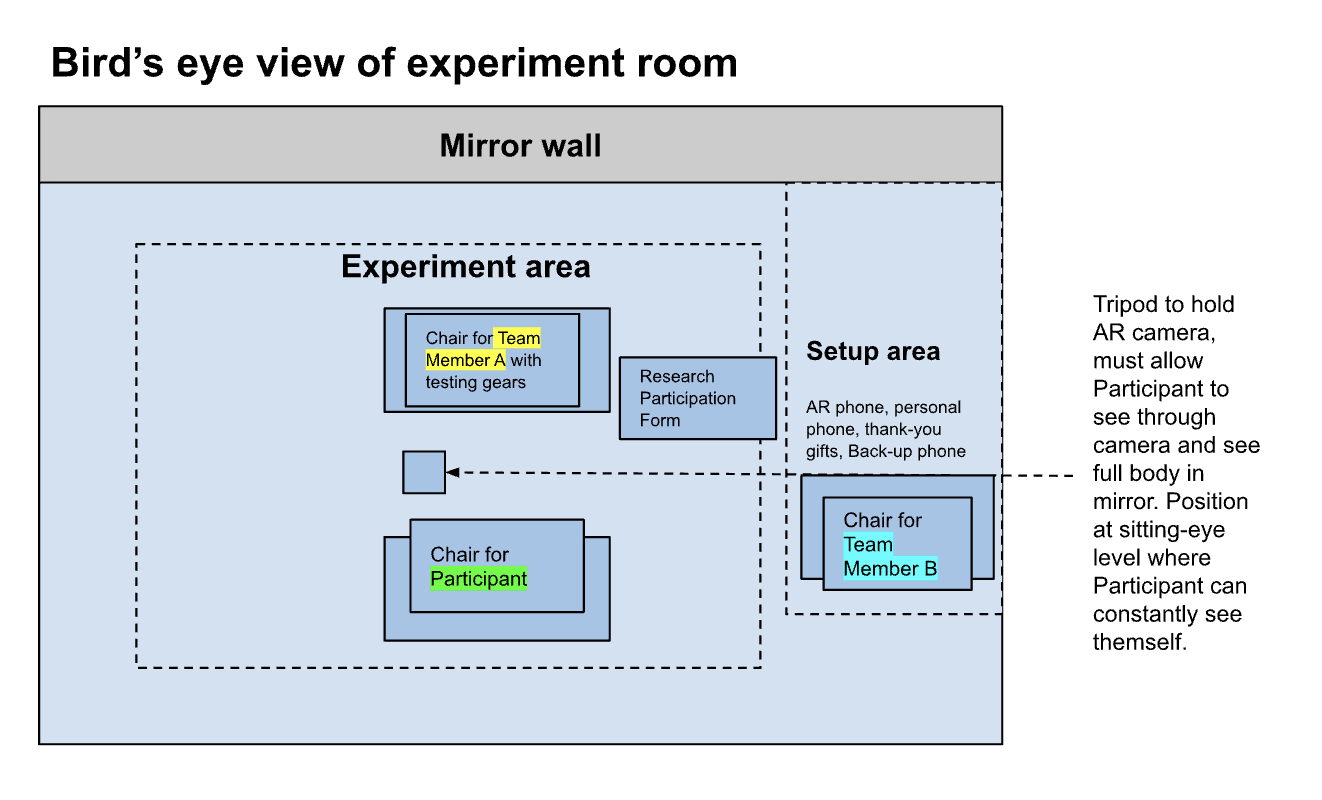
Participant procedure
-
Facing a mirror wall, participants observed themselves in the AR coat while a guided sequence — raise your hands, turn around, jog in place, stretch — helped the outfit feel physically present before testing began.
-
Measures cognitive interference and focus — naming the ink color of a word even when the word names a different color, while still wearing the AR coat.
-
A creativity measure: name ten unrelated words. Greater semantic "distance" between them signals higher originality, scored with the DAT test.
-
A short-term memory check — recall a number shown at the start of the session after completing every other task.
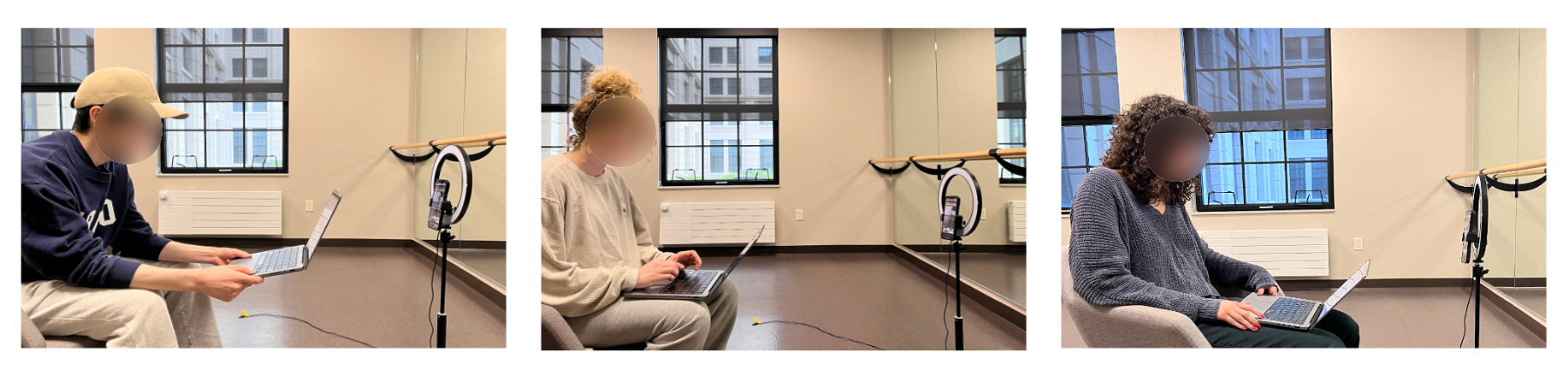
Participants do the Stroop test while wearing a coat in AR.
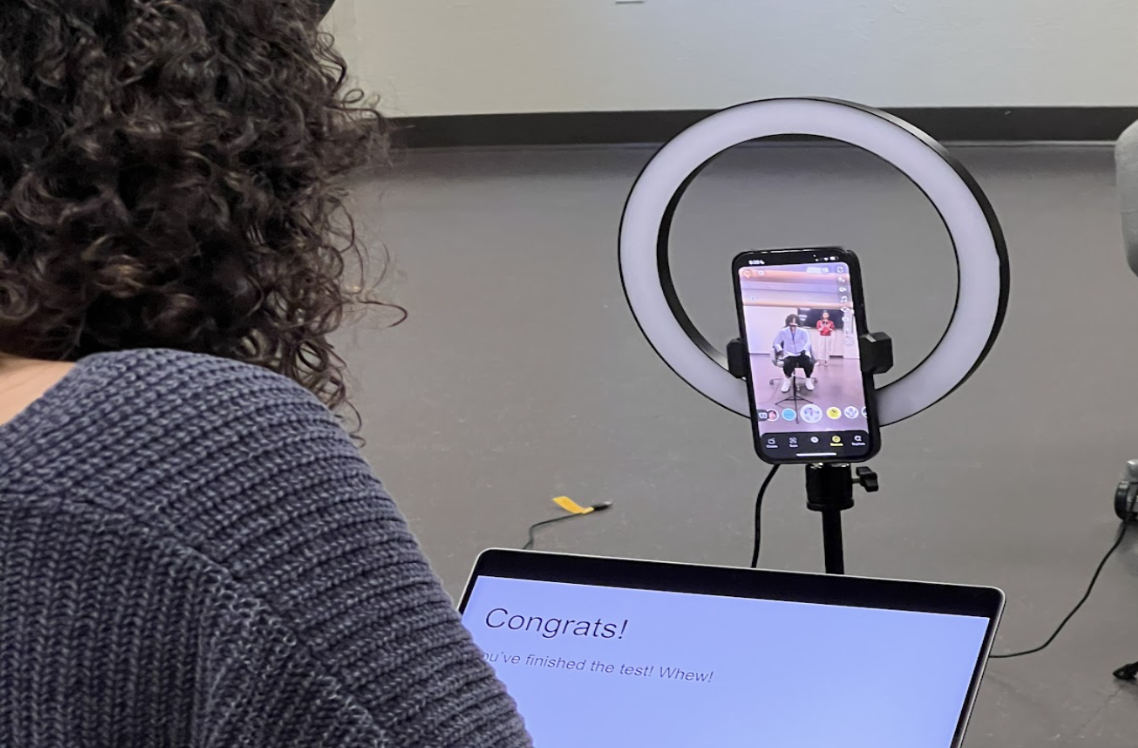
Phone faces participants, so they are aware that they’re wearing an AR coat throughout the whole experiment.
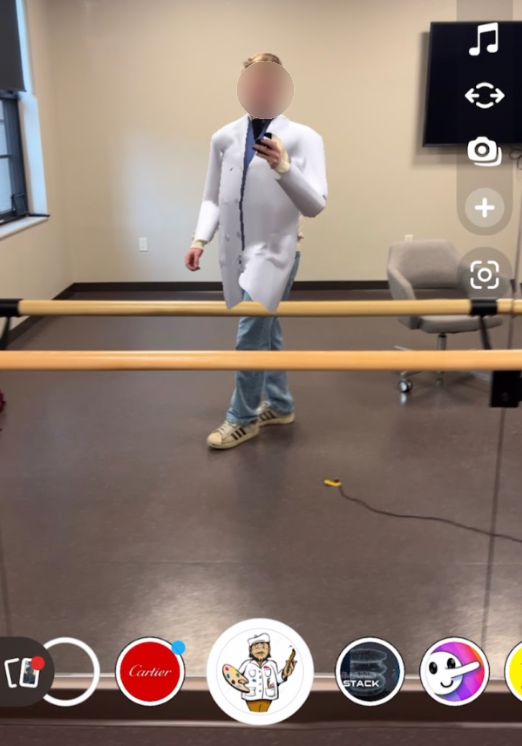
Embodiment activity with AR coat.
04 — Findings
The results were honest, not tidy.
The doctor's coat condition supported stronger attention on the Stroop test: fewer errors, faster responses.
The painter's coat was expected to boost creativity, but the doctor's coat group performed unexpectedly well too. AR clothing effects aren't a clean one-to-one symbolic cue.
The memory task held the biggest surprise: the control group outperformed both AR coat groups, raising real questions about distraction, session length, or the cognitive load of AR itself.
05 — Conclusion & reflections
The most interesting takeaway wasn't "AR coats boost cognition."
It was that virtual embodiment can create measurable psychological questions worth designing around: a small, honest signal that identity and self-perception don't stop being real just because the clothing is.